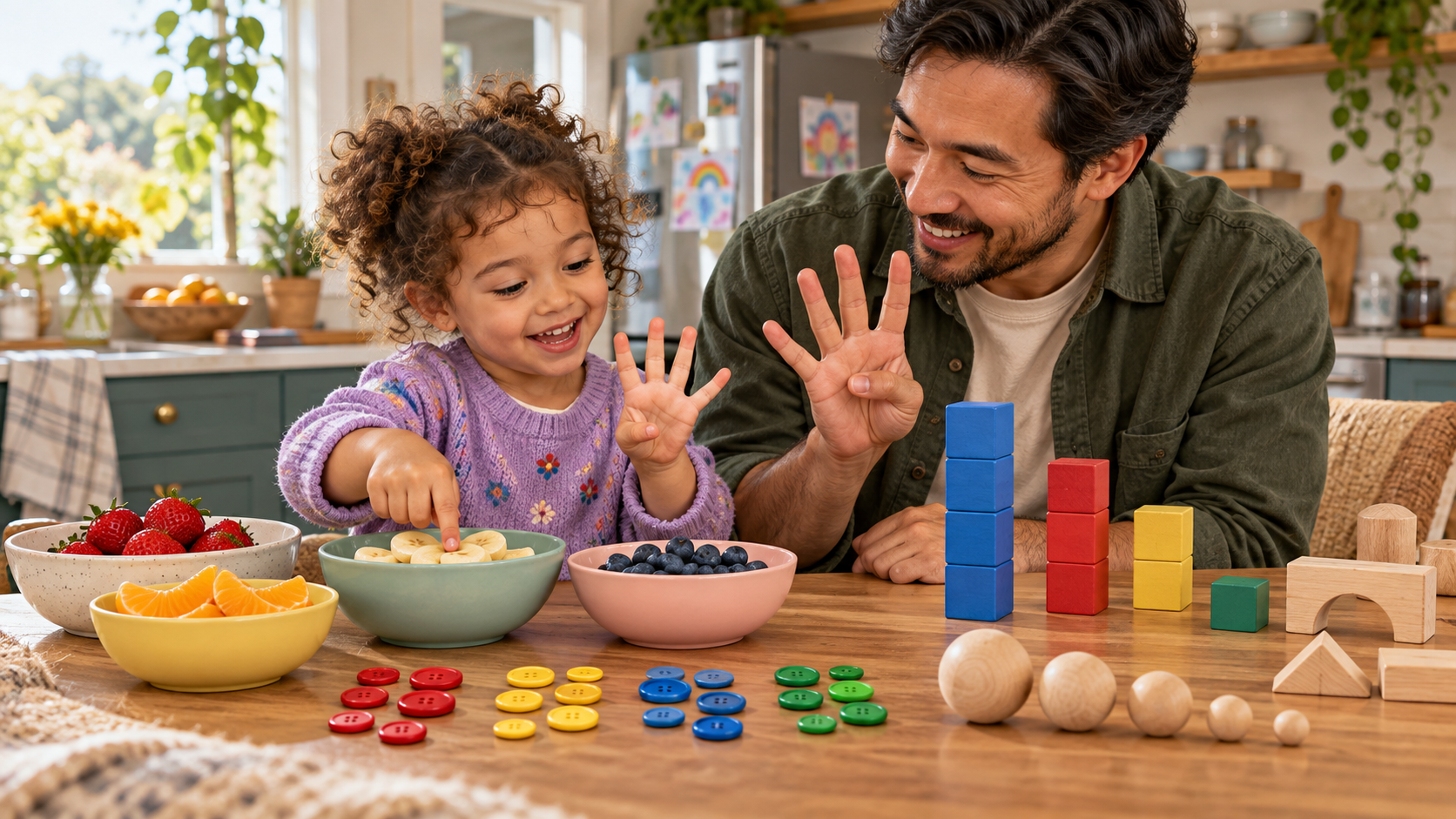
<p>Early math is already happening when a child asks for more crackers, notices that one tower is taller, matches two socks, or argues that a sibling received the bigger piece. Children ages 2 to 5 build mathematical thinking through movement, conversation, and play. They do not need a stack of worksheets to begin understanding number, pattern, shape, size, and space.</p> <p>Count real objects slowly. Touch or move each item once while saying one number word, then name the total: “One, two, three. There are three cars.” Young children may recite numbers before they understand that the last word tells how many. Small groups of snacks, steps, blocks, or stuffed animals make the idea concrete.</p> <p>Ask for a number during useful tasks. “Please put two spoons on the table” connects a word to a quantity. If the child brings three, count together rather than announcing failure. Begin with amounts the child can manage and increase gradually. Accuracy grows through repetition in meaningful situations.</p> <p>Compare without turning everything into a competition. Which ribbon is longer? Which cup holds more? Which pile has fewer? Invite the child to predict, test, and change their mind. Adults can model precise words such as longer, shorter, heavier, lighter, equal, empty, and full while accepting the child’s everyday language too.</p> <p>Sort objects in different ways. Laundry can be grouped by owner, color, or type. Buttons can be sorted by size and then reorganized by holes. Ask how the child decided where something belongs. There may be more than one reasonable rule, and explaining the rule is part of the thinking.</p> <p>Build patterns with claps, steps, blocks, fruit, or beads large enough to be safe. Start with a simple repeat such as red-blue-red-blue. Pause and ask what comes next. Later, try two claps and one stomp. Patterning helps children anticipate structure, but the game should stay flexible enough for them to invent a pattern of their own.</p> <p>Use shape words beyond naming flashcards. Hunt for circles and rectangles in the room, turn a triangle to see that it remains a triangle, and combine blocks to make a new shape. Talk about corners, sides, curves, and position. A square cracker and a square window share important features even though their sizes and materials differ.</p> <p>Spatial language grows during ordinary movement. Say, “The shoes are under the bench,” “Step between the cones,” or “Put the puzzle piece beside the tree.” Obstacle courses, block buildings, puzzles, and setting the table help children understand position and direction with their whole bodies.</p> <p>Cooking offers generous math practice. Children can count scoops, compare measuring cups, notice a timer, divide fruit between bowls, and watch ingredients change. Keep the task safe around heat, sharp tools, and choking hazards. The goal is participation and conversation, not a perfectly measured final product.</p> <p>Board games with short paths, dice, matching, or turn-taking can support number sense. Choose games that fit the child’s attention span and play cooperatively at first. If losing overwhelms the child, focus on moving pieces and finishing together. Emotional regulation is part of being able to stay in the mathematical problem.</p> <p>Avoid correcting so quickly that the child stops thinking. Ask, “How did you figure that out?” or “Can we check it another way?” A wrong answer can reveal a useful strategy. Praise persistence, noticing, and revision rather than calling the child a math genius. Ability grows; it is not a fixed label.</p> <p>Use the language your family speaks most comfortably. Number ideas do not belong to one language, and children can learn mathematical words in more than one. Songs, finger plays, cultural games, cooking traditions, and family routines all carry patterns and quantities worth exploring.</p> <p>Money and time can appear in pretend play without expecting adult-level understanding. A child can exchange play coins in a store, notice that bedtime comes after the bath, or use a picture schedule to see what happens first and next. Clocks and coin values are complex; early practice is about sequence, comparison, and purpose, not memorizing facts before they make sense.</p> <p>Books add mathematical conversation when adults notice quantity and space in the pictures. Count a small group, compare two characters’ paths, predict which container will fit, or look for a repeating design. Do not interrupt every page for a question. One genuine observation can connect story and math while preserving the pleasure of reading together.</p> <p>Take photos of the child’s block structures or patterns before cleanup when they want to remember them. Later, ask what they might build differently. Revisiting a creation supports planning, comparison, and the idea that thinking can continue even after the materials are put away.</p> <p>Talk with the pediatrician or teacher if the child consistently cannot learn small quantities with practice, loses skills, or struggles broadly with language, attention, vision, hearing, or motor tasks that affect play. Milestones describe a range, not a deadline for advanced academics. The strongest start is frequent, enjoyable experience with real objects and an adult who is curious alongside the child.</p>
Building Early Math Skills Through Play
Early math is already happening when a child asks for more crackers, notices that one tower is taller, matches two socks, or argues that a sibling received the bigger piece. Children ages 2 to 5 build mathematical…
By Rick Lofton · October 25, 2026
More stories
More education-learning
 education-learning
Early Literacy Without Pressure
A 4-year-old does not need to read independently to be on the road to literacy. Long before children decode printed words, they learn that stories carry meaning, pages turn in order, sounds can be played with, and marks…
Read more →Oct 24, 2026
5 min read
 education-learning
Traveling With Toddlers and Preschoolers
Travel with a child ages 2 to 5 is rarely relaxing in the adult sense. It can still be enjoyable when the plan matches the child's body, attention, and need for predictability. The most useful preparation is not packing…
Read more →Oct 20, 2026
5 min read
 education-learning
Everyday Learning at Home
A preschooler does not need a miniature classroom at the kitchen table. Language, math, science, movement, and problem-solving are already present in cooking, laundry, bath time, errands, and play. The adult's job is to…
Read more →Oct 9, 2026
5 min read
The OWL Weekly
A small letter from Larissa, every Sunday.
One short video, one free printable, one cultural note, one small parenting win. Five minutes to read — written like a note to a friend.
Double opt-in via Beehiiv. Unsubscribe anytime.
