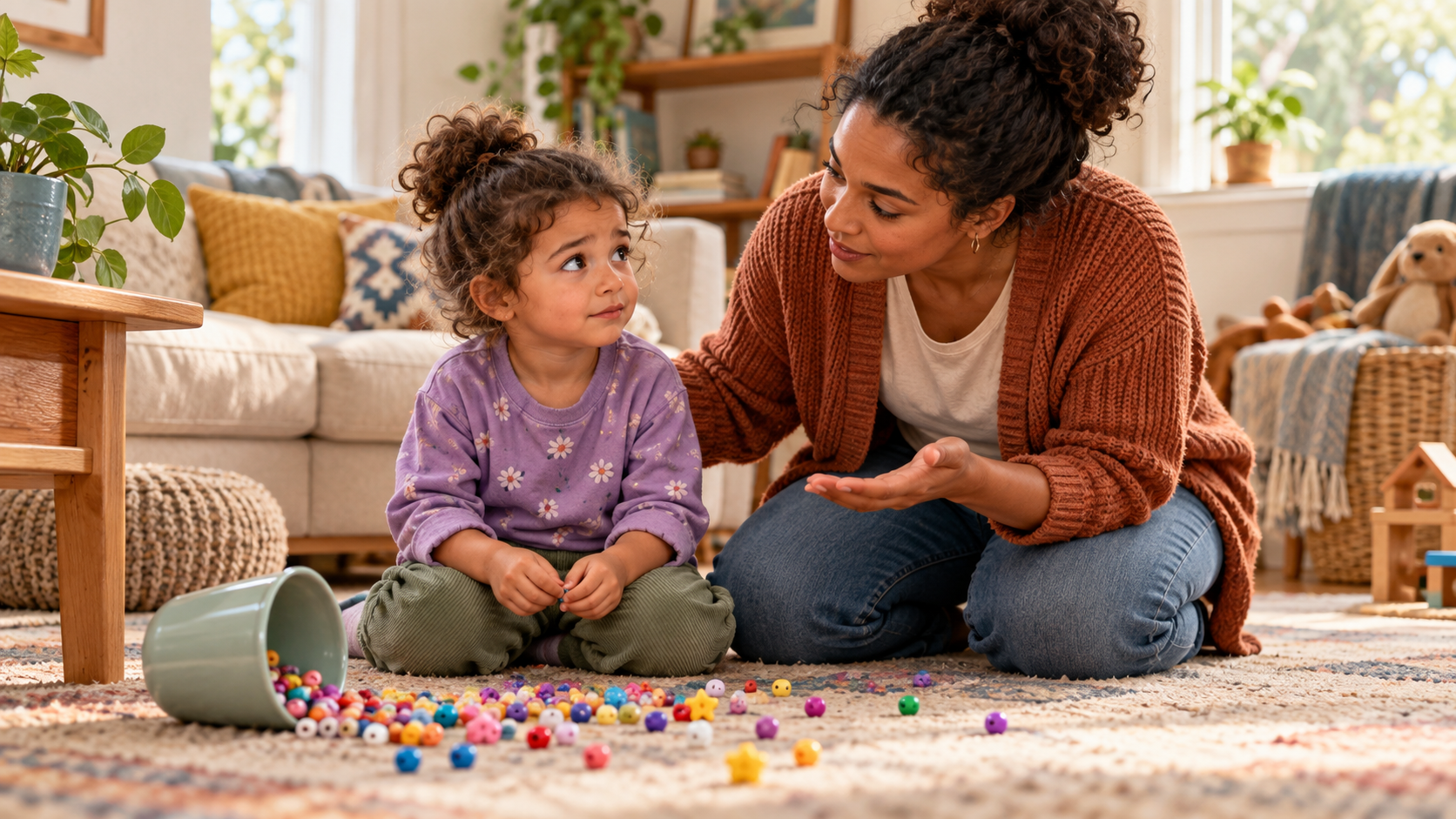
<p>A preschooler looks at a crayon-covered wall and says, with complete seriousness, “I did not do it.” For an adult, the evidence seems obvious. For a child ages 2 to 5, the moment may include wishful thinking, fear of an angry response, a shaky understanding of truth, and a powerful desire to make the problem disappear. Honesty is still developing alongside memory, imagination, language, and self-control.</p> <p>Young children do not always separate fantasy, mistakes, and deliberate deception the way adults do. A 3-year-old may describe an imaginary event as if it happened. A 4-year-old may change a story after hearing a leading question. A 5-year-old may knowingly hide a broken toy to avoid trouble. These situations call for guidance, but labeling the child a liar turns a developing behavior into an identity.</p> <p>Begin with calm facts. “The beads are on the floor, and I saw the cup tip over” is easier to hear than “Why are you lying to me?” If you already know what happened, do not set a trap by asking a question that invites denial. State the problem and move toward repair: “We need to pick these up so nobody slips.”</p> <p>Make truth safer than concealment. This does not mean removing every consequence. It means responding in a way that leaves room for honesty. A child who admits drawing on the table can help clean it and practice using paper. If confession leads to yelling, humiliation, or a punishment far larger than the mistake, the child learns to protect themselves rather than tell the truth.</p> <p>Notice honest moments specifically. Say, “You told me you spilled the milk even though you were worried. That helped us fix it.” Avoid praising the child as naturally good or honest, because then a later mistake can feel like a threat to who they are. Focus on the action and why it mattered.</p> <p>Keep consequences connected. If a toy is thrown and breaks, the child helps gather the pieces and the toy is unavailable. Taking away a birthday party days later may create fear without teaching responsibility. A brief, predictable response makes it easier for the child to understand that telling the truth does not erase the problem, but it helps the family solve it.</p> <p>Model the standard you want. Children hear adults say they are not home, invent an excuse, or deny eating the last cookie. They also notice when an adult admits, “I forgot,” “I was wrong,” or “I said that because I felt embarrassed.” Age-appropriate honesty from adults shows that mistakes can be acknowledged without losing love or belonging.</p> <p>Use stories and pretend play to explore choices. Ask what a character could do after knocking over a tower or taking a marker. Keep the conversation curious rather than turning every book into a lesson. Preschoolers often reveal what worries them through play, and rehearsing a repair can make the real response easier later.</p> <p>Be careful with questions about events you did not witness. Young children can be influenced by repeated or suggestive questions. Ask open prompts such as “Tell me what happened next,” and avoid supplying details. If the concern involves possible abuse or a serious safety issue, listen without conducting your own investigation and contact the appropriate pediatric or child-protection professional.</p> <p>Some false statements are bids for attention or connection. A child who tells an impossible story about a pet dragon may be inviting you into play, not trying to mislead you. You can join the imagination while naming reality: “That is a wonderful pretend story. In real life, our pet is the cat.”</p> <p>Repeated lying may point to a problem beneath the story. The child may fear a harsh response, struggle to remember a sequence, misunderstand a rule, imitate someone else, or lack the skill needed to meet an expectation. Look at when the behavior happens and what the child seems to gain or avoid before deciding how to respond.</p> <p>Talk with the pediatrician or a child-development professional when deception is unusually frequent, elaborate, or tied to stealing, aggression, serious rule-breaking, or intense fear. Also seek help if the child regularly seems confused about reality or has major changes in sleep, mood, or behavior. Support should address the whole child, not simply force an admission.</p> <p>Think about the language adults use when the child tells an uncomfortable truth. “Thank you for telling me” does not mean the behavior was acceptable. It means honesty is useful. Follow it with the boundary: “You still may not take your brother’s toy, and now we can return it.” This sequence helps the child experience truth and responsibility together instead of believing one cancels the other.</p> <p>Avoid demanding promises such as “You will never lie again.” A preschooler cannot guarantee future self-control, and breaking the promise can create another layer of secrecy. Use a plan tied to the next situation: “If something spills, come get me. We will clean it together.” Specific action is easier for a young brain to remember than a permanent moral pledge.</p> <p>Honesty grows through thousands of ordinary moments. A steady adult names what happened, keeps the consequence reasonable, welcomes the truth, and helps with repair. The goal is not a preschooler who never denies a mistake. It is a child who gradually learns that truth makes problems more manageable and that accountability can exist inside a secure relationship.</p>
Why Preschoolers Lie and How Honesty Develops
A preschooler looks at a crayon-covered wall and says, with complete seriousness, "I did not do it." For an adult, the evidence seems obvious. For a child ages 2 to 5, the moment may include wishful thinking, fear of an…
By Rick Lofton · October 21, 2026
More stories
More child-development
 child-development
When Preschoolers Exclude or Feel Left Out
Preschool friendships can change between breakfast and pickup. A child may announce, "You cannot come to my party," or return home saying nobody would play. Those words hurt, but they do not always mean the same thing…
Read more →Oct 23, 2026
5 min read
 child-development
Helping Your Child Make Friends
Watching a child hover at the edge of a playground can tug at a parent's heart. Friendship looks simple from across the sandbox, but it asks young children to notice another person, enter play, share an idea, handle…
Read more →Oct 22, 2026
5 min read
 child-development
Helping Your Child Move On From Pacifiers or Thumb Sucking
Sucking is a normal way for babies and young children to soothe themselves. A pacifier or thumb may help with sleep, separation, boredom, or stress long after infancy. The habit becomes a family concern when it…
Read more →Oct 19, 2026
5 min read
The OWL Weekly
A small letter from Larissa, every Sunday.
One short video, one free printable, one cultural note, one small parenting win. Five minutes to read — written like a note to a friend.
Double opt-in via Beehiiv. Unsubscribe anytime.
